
 英语
英语
.jpg) By: Ethan
By: EthanMaterials & Packaging Science
The Heat Line Between CPET and PET
Two plastics that look nearly identical on a shelf behave in completely different ways once temperature enters the equation — and that difference decides whether a container survives the oven or collapses inside it.
The Direct Answer
In practical terms, CPET plastic can withstand continuous service temperatures between 200°F and 400°F (roughly 93°C to 204°C), which is exactly why it appears in ovenable trays and hot-fill containers. Standard PET plastic, by contrast, begins to soften once temperatures pass 160°F to 170°F (about 71°C to 77°C), placing it firmly outside oven-safe territory. That gap of well over two hundred degrees is not a footnote — it is the single fact that should drive most packaging decisions involving heat.
If a product will ever see direct oven heat, hot-fill processing, or a freezer-to-oven transition, CPET is almost always the correct material. If the product stays cold or is consumed at room temperature, PET remains a lighter, more economical, and highly recyclable choice. Everything else in this piece explains why that line exists and where it matters most.
Why Crystallization Changes Everything
The "C" in CPET stands for crystallized, and that single word explains almost the entire performance gap. Standard PET is an amorphous polymer — its molecular chains sit in a loose, tangled arrangement, not unlike a ball of string dropped on a table. Once heated past its glass transition point, those chains gain enough energy to slide past one another, and the material softens, sags, and eventually loses its shape entirely.
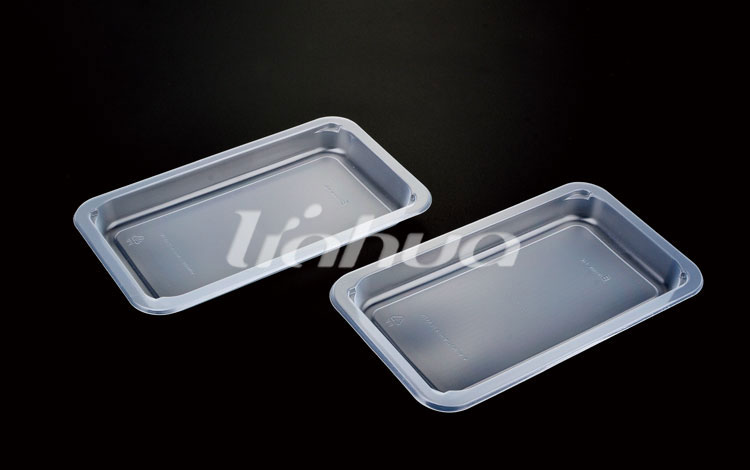
CPET plastic goes through a controlled heating-and-cooling cycle during manufacturing that forces those same chains into an ordered, semi-crystalline lattice. Picture the difference between loose string and a woven mesh — the woven structure resists movement even under stress. That locked-in architecture is what allows a cpet tray to hold its shape at temperatures that would turn an ordinary PET container into a puddle of soft plastic.
cpet tray.jpg)
Crystallization does not just raise the melting point — it changes how the polymer behaves under every kind of thermal stress, from a slow oven warm-up to a sudden freezer-to-oven shock.
Glass Transition, in Plain Terms
Every plastic has a glass transition temperature — the point where it shifts from rigid and glassy to soft and rubbery. Standard PET reaches this state around 165°F (74°C), which is precisely why bottled-water containers and clamshell packaging are labeled against oven use. CPET's crystalline backbone pushes that threshold much higher, closer to 230°F (110°C), giving it the structural patience to survive real cooking conditions rather than just a brief reheat.
Where the Two Materials Actually Get Used
Temperature ratings only matter in the context of how a container is actually handled. The list below reflects how CPET and PET separate along real, everyday use cases rather than laboratory numbers alone.
- Cold storage and refrigeration — both materials perform comfortably, tolerating temperatures down to roughly -40°F without becoming brittle.
- Room-temperature dry storage — PET is entirely sufficient here, and often the more cost-effective option for shelf-stable goods.
- Microwave reheating — both can tolerate microwave conditions, though CPET food trays are the more consistently rated choice.
- Conventional oven use, 350°F–400°F — this belongs to CPET alone; PET will deform and may release fumes under this heat.
- Hot-fill processing, 180°F–205°F — CPET handles this without difficulty, while PET generally requires a specialized heat-set variant.
Side-by-Side: The Numbers That Matter
The table below lays out approximate thresholds across the conditions packaging teams evaluate most often. Figures will shift slightly by resin formulation and manufacturer, but the pattern holds consistently across the industry.
| Condition | Standard PET | CPET |
|---|---|---|
| Glass transition point | ~165°F (74°C) | ~230°F (110°C) |
| Safe microwave use | Limited, short duration | Consistent, reliable |
| Conventional oven use | Not recommended | Up to 400°F (204°C) |
| Hot-fill liquid tolerance | Up to ~140°F (60°C) | Up to ~205°F (96°C) |
| Minimum cold tolerance | -40°F (-40°C) | -40°F (-40°C) |
What Actually Happens Inside an Oven
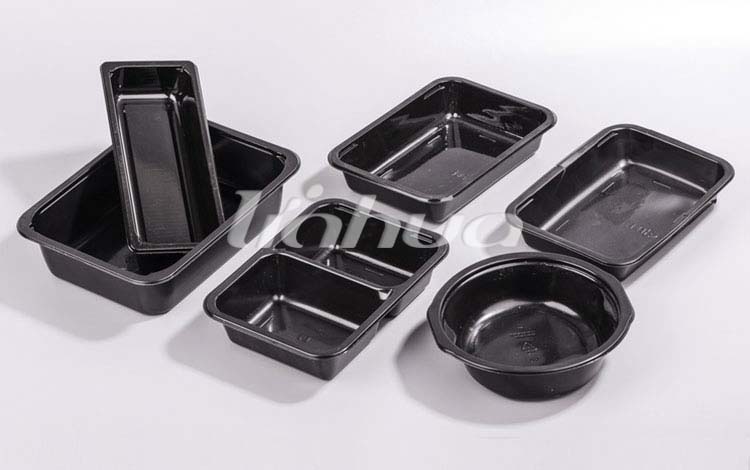
The clearest demonstration of this gap plays out every day in the frozen-food aisle. A cpet tray built for a frozen lasagna or pot pie is engineered to travel from a freezer at -20°F straight into a preheated 375°F oven — no tempering, no thawing step — without cracking, warping, or leaching anything into the food. This freezer-to-oven capability is the defining advantage CPET food trays hold over any PET-based alternative.
The Same Test, With Standard PET
Put a standard PET container through the same routine and the outcome is immediate. Within minutes the walls soften and lose rigidity, the shape begins to sag under the weight of the food, and in more extreme cases the material can partially melt against oven racks or give off an unpleasant odor as the polymer starts to break down thermally. This is exactly why manufacturers print clear "not oven safe" warnings on PET packaging and cap its heat exposure at brief, moderate-power microwave use.
Warning
Never place standard PET containers in a conventional oven or under a broiler. Softening can begin well before visible warping appears, and prolonged heat exposure raises the risk of material migrating into food.
Surviving the Freezer-to-Oven Shock
Heat tolerance is only half the story — CPET trays also need to survive sudden, extreme temperature swings without cracking. Moving a tray from -20°F storage into a 400°F oven creates a temperature differential of well over 400 degrees within seconds. The same crystalline structure that raises the maximum service temperature also improves resistance to this kind of thermal shock.
Typical industry specifications rate CPET trays for oven use up to 400°F for thirty to forty-five minutes, which comfortably covers most home cooking and reheating windows. That reliability is why CPET has become the default across frozen entrées, airline catering, and institutional food service — anywhere thermal consistency isn't optional.
Good Practice
When specifying CPET trays for frozen meal packaging, confirm the manufacturer's oven-rating window matches your product's expected cook time, not just its peak temperature.
How PET Fails When Pushed Too Far
PET's failure mode is gradual rather than sudden, which is part of why some users assume it's more heat-tolerant than it actually is after a few uneventful microwave cycles. The progression tends to follow a predictable sequence:
- Initial softening — container walls turn flexible and may bow outward under the weight of contents.
- Visible deformation — warping appears, especially at thinner sections of the container.
- Structural collapse — in severe cases, partial melting occurs, leading to spills.
- Migration risk — sustained high heat raises concern over compounds transferring into food, which food-safety guidance consistently advises against.
Danger
Do not attempt to "push" PET packaging past its rated limit even briefly. Once softening begins, structural failure can follow quickly and without warning.
Choosing the Right Material for the Job
For anyone specifying packaging, the decision ultimately comes down to matching the material to the product's thermal journey — not just its appearance or cost per unit. A few questions tend to settle the choice quickly:
- Will the container ever be exposed to conventional oven heat?
- Does the product need a freezer-to-oven or freezer-to-microwave transition?
- Is hot-fill processing part of the manufacturing line?
- Will the end consumer reheat the product directly inside the packaging?
Info
If the answer to any of the questions above is yes, CPET food trays are the appropriate solution — they provide the thermal stability standard PET simply cannot match.
In Summary
The maximum service temperature gap between CPET and PET is both real and practically decisive. CPET is rated for continuous use up to roughly 400°F, while PET's threshold sits closer to 160–170°F — a difference that traces directly back to the crystallization process separating the two materials. For anything involving oven use, hot-fill processing, or a freezer-to-oven transition, a cpet tray delivers the reliability and safety margin that standard PET cannot offer. Anyone specifying packaging for frozen meals or prepared foods should treat this temperature distinction as a first-order factor — one that protects both the product and the person eventually opening it.



Post Comment