
 英语
英语0086 574 87739122

 By: Ethan
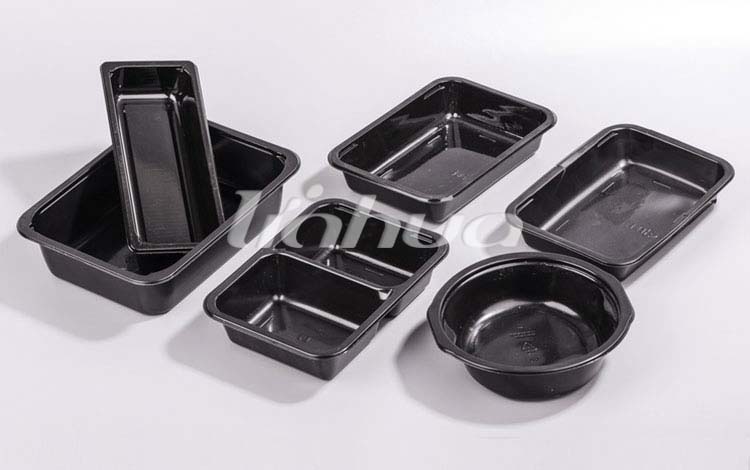
Put a tray in front of a food manufacturer and the first question is usually practical: will it survive the deep-freezer, the oven, an automated filling line, and a consumer’s confidence? For meat processors, prepared-food brands, and meal-delivery kitchens, the answer often starts with CPET food trays. These trays hold their shape from frozen storage to conventional-oven heating, and they seal tightly enough to protect a meal from freezer burn to final warming.
CPET, or crystallized polyethylene terephthalate, starts with the same clear PET familiar from cold drink cups, but the crystallization process changes its behavior. The material forms a stable crystalline structure that resists heat without turning into a limp, deformed container. A well-made CPET food tray can be kept at about -40°C in a blast freezer and heated in a conventional oven up to roughly 220°C. That combination of deep-freeze tolerance and oven safety is rare among plastic trays. Before choosing a material, compare the main tray plastics in the table below.
| Property | CPET | PP | PET (APET) |
|---|---|---|---|
| Typical temperature range | -40°C to 220°C | -10°C to 120°C | -20°C to 60°C |
| Conventional oven use | Yes | No, microwave only | No |
| Freezer use | Yes | Yes | Yes |
| Typical applications | Ready meals, frozen meat, bakery | Portion cups, microwave containers | Fresh produce, chilled products |
The comparison matters because suppliers sometimes call a plain APET tray “ovenable” when it only works in a microwave. A true CPET food tray has enough crystallinity to resist warping and maintain rigidity under heat. Ask for the material test report and a short production trial before you approve the tray for a full line. For a closer look at how the material performs in high-heat cooking, read this overview of the heat-resistance advantages of CPET trays.
Your selection should start with operating conditions, not with price per tray. The following points are the ones we walk through with packaging teams before they choose a specific SKU.
First, verify the tray’s maximum oven temperature and the time it can stay at that temperature. Some CPET trays are rated for 200°C for 30 minutes, while others can handle 220°C for a longer cycle. Check the flange as well; if the flange distorts during heating, the lid will lift and juices can leak into the oven.
Second, think about portion weight, sauce level, and how the meal will be reheated. A shallow tray works for baked goods and vegetables, while a deeper tray keeps headspace low and makes sealing easier for saucy ready meals. Flange width also needs attention because it determines how easily the lidding film can be sealed without wrinkles. Our catalog includes a single-compartment CPET food tray that offers a clean starting point for portion-control testing.
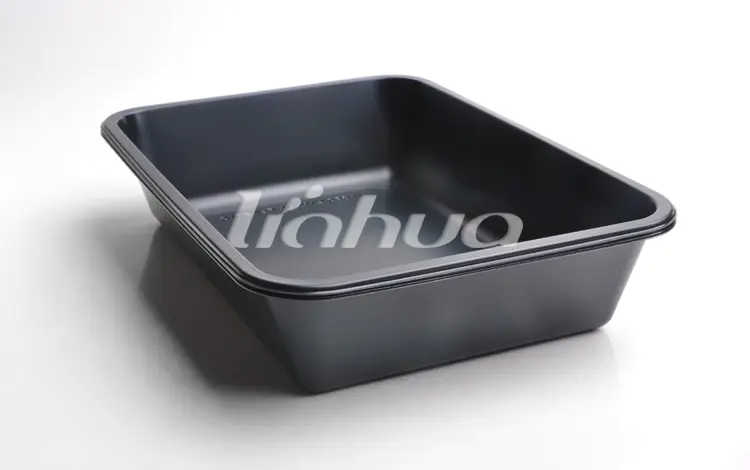 Wholesale Disposable CPET TRAY-1 Manufacturer, SuppliersNingbo Linhua Plastic Co., Ltd wholesale disposable CPET TRAY-1 suppliers and Manufacturers. Welcome to wholesale products.View Product →
Third, confirm that the tray runs reliably on your filling and sealing equipment. CPET trays should have a flat sealing surface, consistent inside dimensions, and enough rigidity to pass through a lidding die without flexing. They should also stack without jamming in a magazine dispenser. If your line runs fast, measure length, width, and depth across several trays; variation of even 0.5 mm can create weak seals. To begin that evaluation, request samples of the CPET tray 6 model as part of your line test.
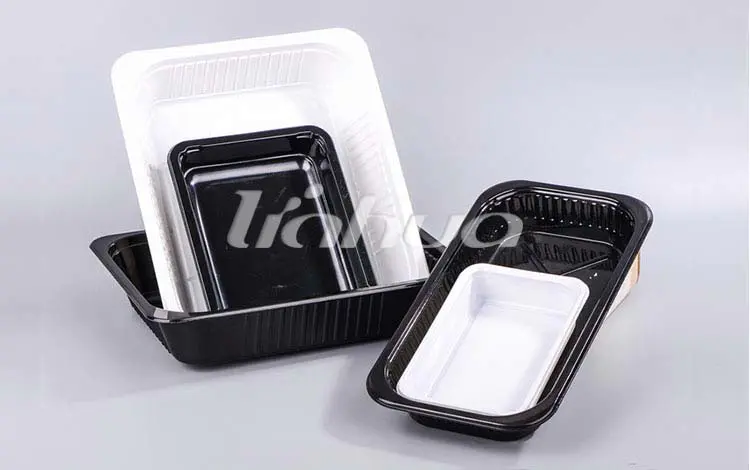 Wholesale Disposable CPET TRAY-6 Manufacturer, SuppliersNingbo Linhua Plastic Co., Ltd wholesale disposable CPET TRAY-6 suppliers and Manufacturers. Welcome to wholesale products.View Product →
From a supply-chain view, CPET food trays simplify operations because they allow food to be frozen, stored, transported, and reheated in the same container. This direct path reduces handling and lowers the risk of contamination.
A CPET tray alone is not a complete barrier package, but it works well with a high-barrier lidding film to slow oxygen ingress and moisture loss. That combination is what keeps frozen meat and ready meals protected for months. If you are designing a full meal system, the tray and film should be validated together, not as separate components. Our food packaging solutions cover trays, high-barrier films, and modified-atmosphere options as one integrated package.
When the food is pre-cooked, frozen, and reheated in the same tray, portioning becomes consistent. That matters for both production efficiency and consumer satisfaction. A tray that can go from the freezer to the oven without cracking or warping also means less product rejected at the final heating step. Because CPET trays are lightweight but rigid, you can ship more units per pallet and reduce transit damage compared with heavier alternatives.
A CPET food tray is a small component in the total meal, but it can cause large problems if it is not aligned with your oven, film, line speed, and cold chain. The best supplier approach is to treat tray selection as part of your packaging line design, not as a one-time SKU purchase.
Before committing to a supplier, ask for food-contact compliance documentation and certifications such as ISO9001, HACCP, or BRC for packaging materials. The resin grade and the injection or thermoforming process control determine whether the tray stays flat during heating or warps in a way that breaks the seal. Production samples are useful, but audit the supplier’s quality process as well. You can review the range of materials and containers in our complete food packaging product range to see what a consistent quality system looks like in practice.
Standard CPET trays solve many problems, yet some products need a non-standard depth, a larger compartment, or a different stacking feature. A supplier with in-house mold design and tooling can adjust dimensions and test prototypes more quickly. This is where a packaging-line consultant role becomes valuable: the same team that helps you choose a tray can help you define a custom version and validate it under production conditions.
CPET food trays are not just a container; they are the link between freezing, storage, reheating, and plate presentation. Start with temperature performance and food-contact compliance, then move to dimensions, sealing, and line compatibility. When those factors are tested together, a CPET food tray becomes one of the most reliable elements of your packaging line.
Food-service packaging · Buyer's guide Small Containers, Big Stakes: Choosing Little Sauce Containe...
Beverage Packaging · Buyer's Field Note Eco Friendly Cups for Cold Drinks: What Buyers Should Actua...

0086 574 87739122
Copyright © Ningbo Linhua Plastic Co.,Ltd. All Rights Reserved.
Disposable Food Packaging Tray Manufacturers


Post Comment