
 英语
英语0086 574 87739122

.jpg) By: Ethan
By: Ethan
Polietilene tereftalato, or polyethylene terephthalate as it is written in English, answers to a single chemical formula: (C10H8O4)n. The Italian name, the English name, and the CAS number 25038-59-9 all identify the same polymer. The formula also explains the most important fact about PET: the n in parentheses means it is a long-chain polymer, not a single molecule, which is why its properties depend as much on processing as on chemistry.
Every repeating unit in PET is formed by reacting terephthalic acid (C8H6O4) with ethylene glycol (C2H6O2) and removing two water molecules. The result is C10H8O4, and the subscript n shows that this unit repeats hundreds of times along the chain. Because chain length varies from one production batch to another, PET does not have a fixed molar mass; typical values fall between 10 and 50 kg/mol depending on the intended application.
This is not an academic detail. A higher molecular weight gives a stronger, more viscous melt, which is why fiber-grade, bottle-grade, and sheet-grade PET are selected against different specifications. A tray supplier cannot simply swap one resin for another and assume the finished tray will behave the same way on an automated filling line.
Two industrial routes dominate PET production. In the most common process, purified terephthalic acid and ethylene glycol are esterified into bis(2-hydroxyethyl) terephthalate, then polycondensed under heat and vacuum to build the polymer chain while ethylene glycol is removed. The older route starts from dimethyl terephthalate and reacts it with ethylene glycol through transesterification; it is still used in some plants but accounts for less new capacity.
The same chemistry can be adjusted. PETG, for example, substitutes a portion of the ethylene glycol with cyclohexanedimethanol, which suppresses crystallization and makes the material suitable for clear, impact-resistant sheets and medical packaging. Bio-based PET replaces fossil-derived monoethylene glycol with plant-derived glycol, yet the formula remains (C10H8O4)n, so bio-PET flows through the same recycling stream as conventional PET.
The formula defines what the molecule is, but the numbers on a datasheet define what the package can do. These are the values most frequently quoted for packaging-grade PET:
| Property | Typical value | Why it matters for packaging |
|---|---|---|
| Chemical formula | (C10H8O4)n | Identifies the repeat unit; CAS 25038-59-9 |
| Density | 1.38 g/cm3 at 20 °C | Explains the light-but-rigid feel of PET bottles and trays |
| Crystalline melting point | About 260 °C | Sets the boundary for hot-fill and oven-safe grades |
| Glass transition temperature | 67 to 81 °C | Defines the safe service range in chilled distribution |
| Intrinsic viscosity | 0.70 to 0.80 dL/g for bottle and sheet grades | Correlates with molecular weight and mechanical strength |
PET is one of the most regulated food-contact polymers, and the record is consistent. It is approved for food contact in the European Union and the United States, carries the resin identification code 1, and is collected for recycling at a higher rate than most other thermoplastics. The structure (C10H8O4)n contains no plasticizers, and PET does not depend on the additive packages that raise questions in some other food packaging materials. Its main limitation is flavor absorption: PET can take up small amounts of limonene and other volatile compounds from citrus juices and oils, which is why beverage and sauce applications often add a thin barrier coating.
Two safety topics come up repeatedly in factory audits. The first is antimony: most PET is polymerized with an antimony-based catalyst, and trace migration into food is possible. A production line that controls catalyst levels and washing stages keeps residual antimony far below European and US migration limits. The second is acetaldehyde, a by-product created when PET is melted. It affects taste in water and other sensitive liquids before it affects safety, which is why bottle and tray processing controls temperature and residence time. When choosing a tray manufacturer, ask for migration test reports and acetaldehyde data rather than accepting a generic resin certificate.
Amorphous PET, commonly called A-PET, is transparent and easy to thermoform, which makes it a standard material for fruit punnets, salad boxes, and bakery packaging. Crystallized PET, or CPET, is nucleated and converted to a higher crystalline structure during thermoforming so that it can be reheated without collapsing. For prepared meals that are cooked or reheated in the package, CPET food trays move from freezer to fan-assisted oven while keeping enough rigidity for automated filling and sealing lines. PET trays also offer a clearer view of the product than polypropylene or pulp alternatives, and they resist fatigue and cracking at chill-chain temperatures better than many polyolefins.
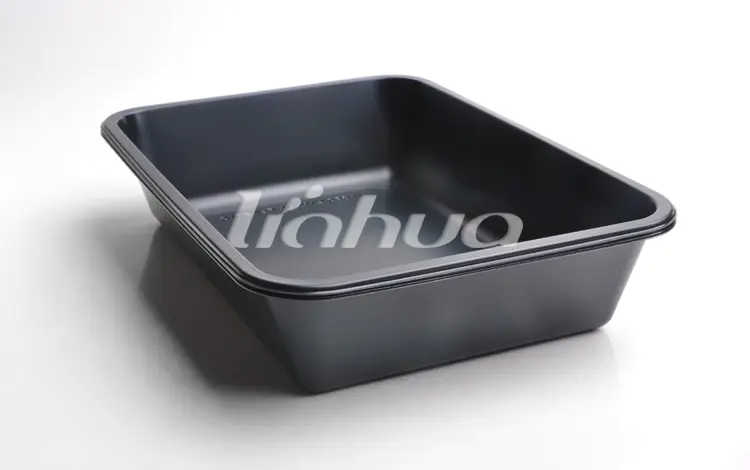 Wholesale Disposable CPET TRAY-1 Manufacturer, SuppliersNingbo Linhua Plastic Co., Ltd wholesale disposable CPET TRAY-1 suppliers and Manufacturers. Welcome to wholesale products.View Product →
For fresh and processed meat, the first performance check is juice control. A moisture retention tray keeps purge below a structured base, so the product is not sitting in liquid by the time it reaches the retail shelf. This matters beyond appearance: free water accelerates microbial growth, and purge that is drained away means product weight loss. The result is fewer package reworks, more consistent pack weights, and less waste at the retailer. Processors that want a detailed comparison against pulp and foam trays can check our notes on PET trays for meat packaging.
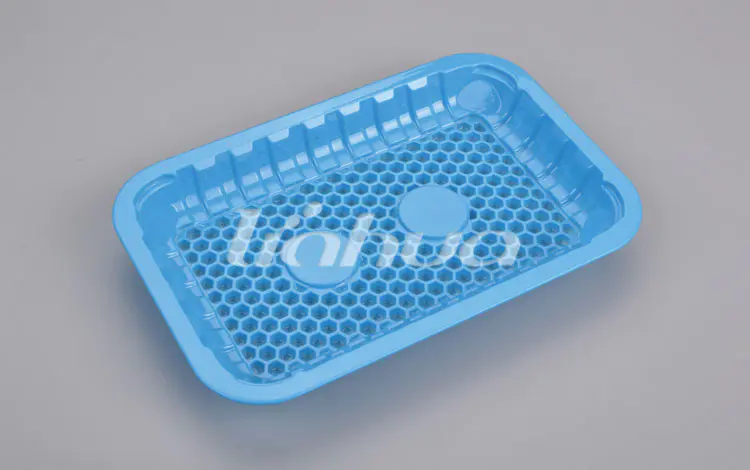 PET Tray For Meat Packaging For Sale, Moisture Retention TraysNingbo Linhua Plastic Co., Ltd is professional moisture retention trays supplier, we offer various disposable plastic PET trays for meat ...View Product →
When the goal is extended chilled shelf life, PET usually works as the structural layer rather than the barrier. A MAP tray for modified atmosphere packaging can be thermoformed from PET and combined with an EVOH barrier insert or a high-barrier lidding film. The PET contributes stiffness, impact resistance at low temperature, and a sealing surface that runs reliably on automatic equipment, while the barrier layer manages oxygen and carbon dioxide exchange. Tray geometry matters as much as material: a flange that flexes during handling can break the seal or allow oxygen to leak past the lidding film, so dimensional tolerance and sheet thickness must be verified together.
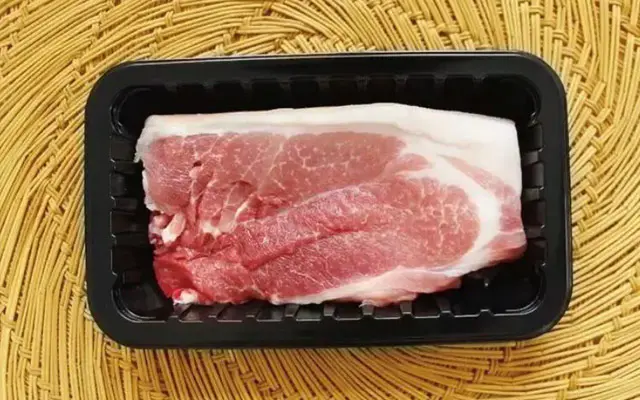 Wholesale Disposable MAP tray Manufacturer, SuppliersNingbo Linhua Plastic Co., Ltd wholesale disposable MAP tray suppliers and Manufacturers. Welcome to wholesale products.View Product →
A resin formula is identical from one manufacturer to another; the quality of the finished tray is not. Use three checks when you evaluate a supplier:
As a PET packaging manufacturer with more than twenty years of experience, we apply the same sequence in our own factory. We start with the resin specification, check intrinsic viscosity for the intended forming process, then validate crystallinity, thickness distribution, and seal strength on production samples. The formula (C10H8O4)n tells you what the material is; the production line tells you what the package will do.
.jpg?imageView2/2/w/600/h/600/format/webp/q/75)
Materials and Sourcing CPLA Plastic: Heat Resistance, Compostability and the Sourcing Details That ...
.jpg?imageView2/2/w/600/h/600/format/webp/q/75)
Corn Starch Bioplastic: What Holds Up and What Fails Corn starch is neither a wonder material nor a...

0086 574 87739122
Copyright © Ningbo Linhua Plastic Co.,Ltd. All Rights Reserved.
Disposable Food Packaging Tray Manufacturers


Post Comment