
 英语
英语0086 574 87739122

 By: Ethan
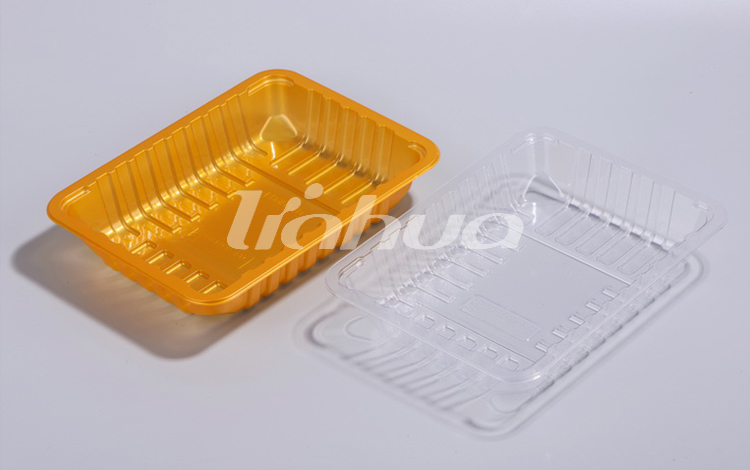
The correct tray depth for a Vacuum-packed (VSP) Tray should be at least 10–15 mm deeper than the tallest point of the product, and the tray geometry must closely mirror the product's footprint to allow the skin film to drape uniformly without bridging, wrinkling, or incomplete contact. Getting this right from the start eliminates the most common VSP defects and directly protects shelf life, seal integrity, and retail presentation.
This guide walks through the practical methodology for sizing a Vacuum-packed (VSP) Tray correctly — covering depth calculation, wall angle selection, flange dimensions, and how product shape complexity should influence every decision.
In a Vacuum-packed (VSP) Tray, the skin film is heated to between 130°C and 160°C and then drawn down over the product by vacuum pressure — typically between 5 and 20 mbar residual pressure. The film must travel from the flange plane all the way down and around the product contours before sealing to the tray base.
If the tray is too shallow, the film cannot fully conform to the product's sides and undercuts, creating air pockets that compromise the vacuum and accelerate oxidation. If the tray is too deep, excess film material folds and wrinkles at the base, producing an unattractive pack and potential leak points at the seal zone.
The practical rule: tray inner depth = maximum product height + 10 to 15 mm. For bone-in cuts or seafood with protruding elements, increase the buffer to 18–22 mm to account for film stretching over sharp geometry.
Before specifying any tray dimensions for a Vacuum-packed (VSP) Tray, conduct a structured product profiling process. Irregular products — such as rack of lamb, whole salmon fillets, or stuffed poultry — cannot be treated as simple rectangles.
These measurements directly feed into tray depth and wall geometry specifications and prevent costly tooling redesigns after initial production runs.
The side wall angle — also called the draft angle — of a Vacuum-packed (VSP) Tray plays a major role in how smoothly the skin film conforms to product edges. A wall that is too vertical restricts film travel and causes bridging at the tray corners.
Standard industry guidance recommends a draft angle of 7° to 12° from vertical for VSP applications. For products with pronounced height variation or significant undercuts, increasing the draft to 14°–18° gives the film more room to conform without overstretching.
Sharp internal corners are among the most common causes of film failure in a Vacuum-packed (VSP) Tray. The film must stretch around corners in two axes simultaneously, concentrating stress at that point. As a rule:
The flange is the horizontal rim of the Vacuum-packed (VSP) Tray where the skin film seals to the tray substrate. An undersized or poorly designed flange is one of the leading causes of seal failure in retail VSP packs.
Recommended flange width is 8 to 12 mm for standard retail packs. For larger trays carrying products above 800 g, increase flange width to 12–15 mm to distribute sealing pressure more evenly and reduce the risk of peel-back during transport.
The flange surface must be flat and free of warping. Tray materials with high crystallinity, such as CPET or rPET with >30% recycled content, are more prone to flange distortion during thermoforming and require tighter tooling tolerances — typically ±0.2 mm flatness deviation across the seal zone.
The following table provides a practical reference for selecting Vacuum-packed (VSP) Tray dimensions across the most common product categories processed in skin packaging lines:
| Product Category | Typical Product Height | Recommended Tray Depth | Draft Angle | Special Notes |
|---|---|---|---|---|
| Boneless beef / pork cuts | 20–40 mm | 35–55 mm | 8°–10° | Standard geometry |
| Bone-in chops / rack cuts | 30–60 mm | 50–80 mm | 12°–16° | Use anti-puncture film ≥70 µm |
| Fresh fish fillets | 15–30 mm | 28–45 mm | 7°–10° | Absorbent pad often required |
| Whole prawns / shellfish | 25–45 mm | 40–65 mm | 12°–18° | High-puncture-risk geometry |
| Poultry portions | 35–65 mm | 50–85 mm | 10°–14° | Wide footprint tray recommended |
| Cheese blocks / portions | 20–50 mm | 32–65 mm | 7°–9° | Uniform geometry; simpler drape |
The skin film used in a Vacuum-packed (VSP) Tray is not infinitely stretchable. Most commercial VSP top films are co-extruded structures with a total thickness of 50 to 100 µm and an elongation-at-break of 300% to 600%. However, effective draw depth without thinning or pinholing is significantly more conservative — typically limited to draw ratios of 1:1.5 to 1:2.5 (depth to smallest lateral dimension).
This means that for a narrow tray with an internal width of 80 mm, the maximum reliable skin film draw depth is approximately 120–200 mm. Beyond this, film thinning at the base corners becomes a structural risk. If your product depth exceeds these ratios, the solution is to widen the tray geometry rather than deepen it — distributing the film draw stress over a larger surface area.
For bone-in or sharp-edged products, always specify a film with a minimum puncture resistance of 15–20 N measured by ASTM F1306 or equivalent, regardless of thickness.
Once tray dimensions have been specified, a structured validation trial is essential before committing to full tooling production for a Vacuum-packed (VSP) Tray format. Skipping this step is the most expensive mistake in VSP line commissioning.
Only after passing all six validation stages should final production tooling be commissioned. This process typically adds 3–6 weeks to a new VSP Tray format launch but prevents substantially costlier recalls or line downtime post-launch.
Even experienced packaging engineers encounter recurring geometry errors when specifying a Vacuum-packed (VSP) Tray for a new product. The following are the most frequently encountered issues:
.jpg?imageView2/2/w/600/h/600/format/webp/q/75)
Materials and Sourcing CPLA Plastic: Heat Resistance, Compostability and the Sourcing Details That ...
.jpg?imageView2/2/w/600/h/600/format/webp/q/75)
Corn Starch Bioplastic: What Holds Up and What Fails Corn starch is neither a wonder material nor a...

0086 574 87739122
Copyright © Ningbo Linhua Plastic Co.,Ltd. All Rights Reserved.
Disposable Food Packaging Tray Manufacturers


Post Comment