
 英语
0086 574 87739122

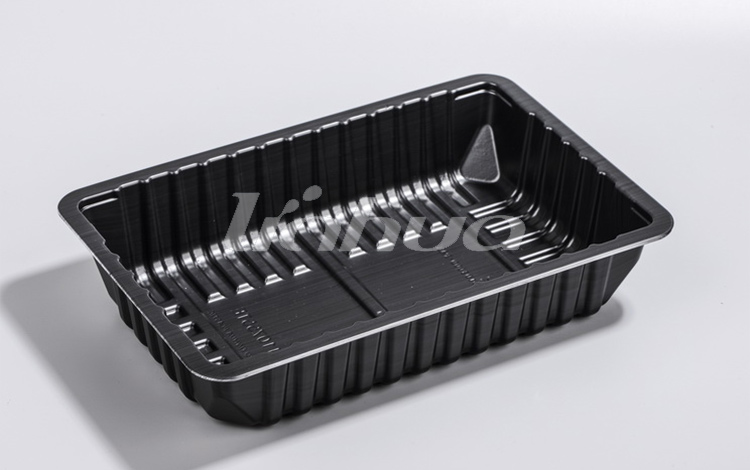 By: Ethan
Most tray sizing disputes are not caused by wrong numbers. They are caused by the right numbers measured on different edges by two people who both used the word "dimension" for something else.
A catering team orders a half tray, 65 mm deep. The sample arrives, the lid snaps on properly, and the tray still jams in the pass-through chute. The chute was measured across the tray base, the quotation was written at the rim, and the gap between those two edges was 14 mm. Nobody was careless; the specification was simply incomplete.
The conclusion first: on any food tray, five measurements decide whether it fits your line, your lid and your pallet. Put all five on one drawing and most fit, leak and stacking problems disappear before a mould is ever cut.
Catalogues list a tray with two or three figures. Production reality needs five, and each one behaves differently when temperature or tooling wear starts to move it.
Two trays with identical top-out dimensions can differ by 15 percent in usable volume, which is why a size chart on its own rarely settles a purchasing decision.
Standard sizes exist, but they are conventions rather than guarantees. Two families dominate: the US steam-table and catering range, and the European Gastronorm (GN) range. They look similar on paper and are not fully interchangeable in a fixed rack.
| Format | Commonly quoted size | Metric equivalent | Typical depth range |
|---|---|---|---|
| Full-size steam-table pan | 20.75 x 12.75 in | 527 x 324 mm | 65 to 200 mm |
| Half-size pan (half tray) | 12.75 x 10.375 in | 324 x 264 mm | 65 to 200 mm |
| Quarter-size pan | 10.375 x 6.375 in | 264 x 162 mm | 40 to 65 mm |
| Gastronorm GN 1/1 | 530 x 325 mm | 530 x 325 mm | 20 to 200 mm |
| Gastronorm GN 1/2 | 325 x 265 mm | 325 x 265 mm | 20 to 200 mm |
| Ready-meal and menu trays | varies by tool | roughly 180 x 130 mm to 275 x 200 mm | 30 to 60 mm |
Two cautions that price lists never carry. First, GN 1/1 at 530 x 325 mm and a US full pan at roughly 527 x 324 mm sit only a few millimetres apart, and three millimetres is enough to stop a lid seating in a fixed rack. Second, a half tray is not half a full tray in area: it keeps the long side but not the proportions, so it holds closer to 40 percent of the covers.
Depth drives fill weight, but volume is the safer way to specify it. A tray with 500 ml of brim-full capacity, filled to a sensible 80 percent line, holds about 400 ml. That is roughly 420 g of sauce at 1.05 g/ml and about 140 g of shredded salad at 0.35 g/ml. Quoting a single 400 g fill across both products guarantees an overflow on one of them.
Thermoformed trays also carry tolerance. A well-run PP tool holds roughly plus or minus 0.3 to 0.5 mm on depth, and cavity-to-cavity variation across a 40-cavity mould can add a few tenths more. Across 500 trays, that band is the difference between a clean seal and a reject pile.
Treat every quoted tray dimension as a nominal value with a band around it, and write the band into the purchase order. "560 x 360 mm" is not a specification. "560 x 360 mm, plus or minus 0.5 mm, measured top-out" is.
Watch the hot fill. A tray that holds 400 ml of cold dressing may hold 370 ml of the same dressing filled at 80 °C. Fill height, viscosity and cooling shrinkage all move in the same direction, so test with the real product at the real filling temperature before you commit to a depth.
Lids are where footprints quietly grow. A snap-on lid adds roughly 0.5 to 1.5 mm to the outer dimension and 1 to 3 mm to packed height, which matters when a case is designed to a fixed cube. A lidding film adds nothing to the footprint but needs its own real estate: at least 3 mm of flat, uninterrupted flange for a reliable seal, and more when seal-head tolerances are loose.
Modified atmosphere packaging raises the stakes further. Gas flushing needs headspace, commonly 10 to 15 mm between the product surface and the film, so a tray that is perfectly sized for a 40 mm burger is 15 mm too shallow the moment MAP is added to the brief.
Six measurements, taken at room temperature with a steel rule rather than a tape:
Buyers working with vacuum skin packaging should add a seventh check, because the limiting dimension there is rarely the tray itself. It is how the film drapes over the highest point of the product, and a 5 mm shoulder on a sausage or a chicken fillet can add more to pack height than the tray depth ever will. It is worth reading up on depth and geometry for vacuum skin trays before the mould is cut.
Tray dimensions become freight dimensions the moment pallet patterns are drawn. On a 1200 x 800 mm pallet, a 600 x 400 mm module holds four 300 x 200 mm trays, giving 16 trays per layer, and a 2.2 m warehouse limit usually sets the maximum stack long before weight does. A 1 mm increase in top-out across a 300 x 200 mm tray looks trivial until it forces a case from 12 trays down to 10.
Automated lines are less forgiving than pallets. Denesting heads, chute guides and sealing dies are built to fixed clearances, and 2 to 3 mm per side is a common allowance. A tray measuring 0.5 mm over the top-out specification can stop a filling line; one measuring 0.5 mm under will leak at the seal. Rigid-rim trays and returnable logistics boxes often travel together in these environments, and both need their dimensions locked in at the same time.
Tolerance stacking: a tray at plus or minus 0.5 mm, a lid at plus or minus 0.3 mm and a film at plus or minus 0.2 mm can consume 1 mm of a 3 mm clearance. Specify the combined figure rather than each component in isolation.
Material choice decides how much a dimension is allowed to move. PP covers chilled, frozen and hot-fill duties up to roughly 100 °C. CPET takes a similar shape into a conventional oven at around 200 to 220 °C. PET suits chilled and frozen display, where clarity helps sell the product. Below about minus 18 °C, PP stiffens and thin walls turn brittle, so impact resistance becomes a sizing question as much as a material one.
Trays also change shape under heat. A tray filled at 85 °C and cooled to 4 °C will contract slightly, and a lid applied warm can sit 0.5 mm out of position by the time the pack reaches the chiller. Warping after a three-minute microwave cycle is the most common reason a lid that sealed perfectly in the factory no longer clicks shut at the customer's table.
A complete tray specification is short, and every line on it prevents a specific argument later:
None of this is complicated, but it does need to be written down before tooling is ordered. A tray dimensioned on all five axes will still generate discussion about colour, print and lead time. It will not generate discussion about whether it fits.
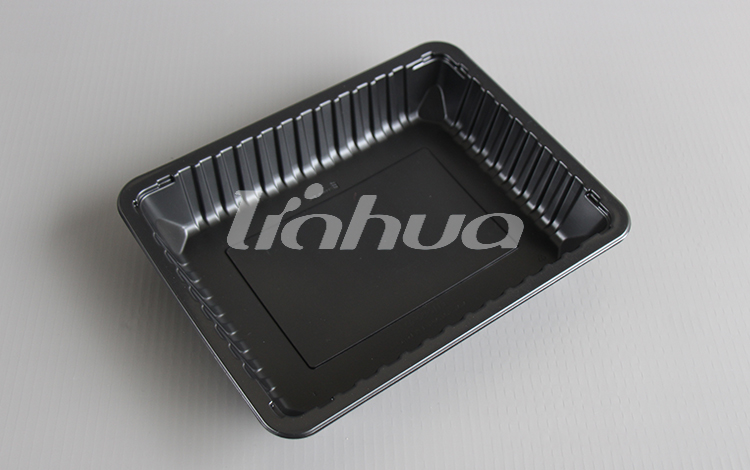
PET Cups, Decoded: What the Name Really Promises PET stands for polyethylene terephthalate and carr...
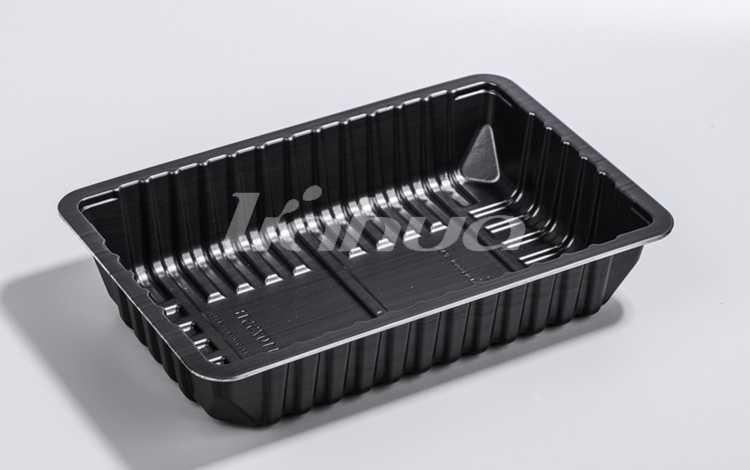
Food Tray Dimensions: The Five Numbers That Decide Whether a Tray Actually Fits Most tray sizing di...

0086 574 87739122
Copyright © Ningbo Linhua Plastic Co.,Ltd. All Rights Reserved.
Disposable Food Packaging Tray Manufacturers


Post Comment