
 英语
英语0086 574 87739122

.jpg) By: Ethan
By: Ethan
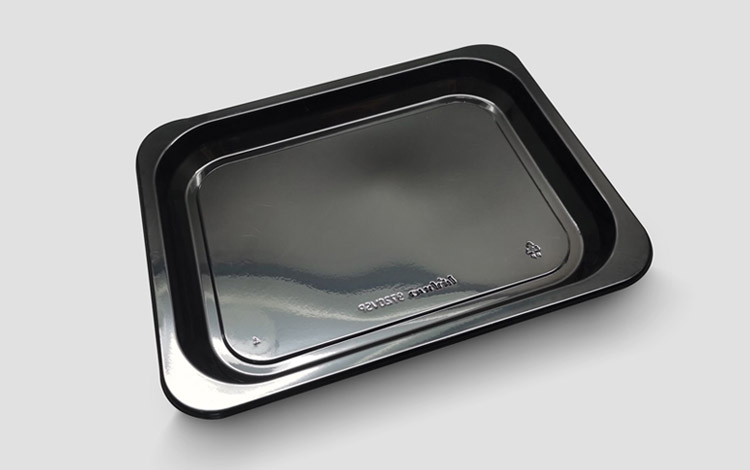
A Plastic Food Tray made from PET (Polyethylene Terephthalate) offers superior moisture resistance compared to one made from EPS (Expanded Polystyrene). PET is a dense, non-porous thermoplastic with low water vapor transmission rates, while EPS is a foam material whose open-cell or closed-cell structure, though insulating, absorbs surface moisture and degrades under prolonged wet conditions. For applications where moisture control is critical — such as fresh meat, seafood, or wet produce — the material choice between PET and EPS directly impacts food safety, shelf life, and packaging integrity.
Moisture resistance in a Plastic Food Tray refers to two distinct but related properties:
A high-performance Plastic Food Tray should score low on both metrics — minimizing moisture loss from food and resisting liquid absorption that can compromise structural integrity, hygiene, and sealing performance. PET and EPS behave very differently on both fronts.
PET is one of the most moisture-resistant commodity plastics available. Its tightly packed molecular structure and semi-crystalline polymer chains make it inherently resistant to both liquid water and water vapor transmission.
These properties make a PET Plastic Food Tray highly suitable for packaging wet or high-moisture foods. The tray maintains its shape, rigidity, and sealing surface even when holding marinated meats, fresh fish, or cut vegetables releasing exudate over days of refrigerated storage.
Additionally, CPET (Crystallized PET) trays — a heat-set variant — retain these moisture-resistant properties while also withstanding oven temperatures up to 220°C, making them suitable for dual-oven and microwave ready meal applications where condensation management is important.
EPS — commonly known by the brand name Styrofoam — is a foamed plastic composed of up to 98% air trapped within a polystyrene matrix. This structure gives it outstanding thermal insulation but creates a fundamentally different moisture profile compared to solid thermoplastics like PET.
In practical terms, an EPS Plastic Food Tray holding fresh chicken or fish will begin to absorb the released drip liquid within hours. Over a 2–3 day refrigerated display period, this can cause the tray base to soften, discolor, and become structurally compromised — a concern both for food safety and retail presentation.
It is worth noting that many EPS trays used for supermarket meat packaging incorporate an absorbent pad placed between the food and the tray base specifically to compensate for the material's poor liquid management. This is an indirect acknowledgment of EPS's moisture handling limitations.
| Property | PET Plastic Food Tray | EPS Plastic Food Tray |
|---|---|---|
| WVTR (g/m²/day) | 1–3 | 100–200 |
| Water Absorption (24hr immersion) | <0.2% | 2–4% |
| Surface Porosity | Non-porous, smooth | Micro-porous foam cells |
| Liquid Drip Handling | Beads on surface, easily drained | Absorbed into foam cells |
| Structural Integrity When Wet | Maintains rigidity | Softens and weakens |
| Heat-Seal Compatibility | Excellent (airtight seal) | Limited (foam surface) |
| Odor/Stain Retention from Moisture | Minimal | Moderate to high |
| Thermal Insulation | Low | Excellent |
The moisture resistance gap between PET and EPS has direct consequences for food preservation and hygiene standards.
Fresh proteins release significant amounts of liquid — known as purge or drip loss — during refrigerated storage. A PET Plastic Food Tray keeps this liquid pooled on the non-porous surface, where it can be managed with an absorbent pad or drained during processing. An EPS tray absorbs this liquid into its foam matrix, creating a warm, nutrient-rich environment that accelerates bacterial growth. Studies have shown that bacterial counts on EPS tray surfaces in contact with raw meat can be 3–5 times higher after 48 hours compared to non-porous plastic surfaces under the same conditions.
MAP packaging requires an airtight seal between the tray and the lidding film. PET's smooth, non-porous flange surface is ideal for heat-seal or adhesive lidding, creating a hermetic barrier that preserves the internal gas mix and prevents external moisture ingress. EPS trays have a foam flange that is difficult to seal reliably — uneven cell structure creates micro-gaps that compromise MAP integrity and allow moisture exchange, effectively shortening the product's extended shelf life.
In frozen food storage, EPS trays perform better than in refrigerated wet applications because liquid activity is reduced. However, during thawing cycles, absorbed moisture can cause EPS to become waterlogged and lose structural strength. A PET Plastic Food Tray maintains full dimensional stability through freeze-thaw cycles, making it more reliable in multi-temperature distribution chains.
Despite its moisture handling limitations, an EPS Plastic Food Tray retains meaningful advantages in specific use cases that justify its continued market presence:
Beyond performance, the regulatory landscape is increasingly influencing which Plastic Food Tray material is chosen. EPS has faced growing legislative pressure globally:
From a circularity standpoint, rPET (recycled PET) Plastic Food Trays are now commercially available and approved for food contact in many markets, offering comparable moisture resistance to virgin PET while reducing environmental impact. EPS recycling infrastructure remains limited globally, with only a small fraction of used EPS trays entering any recovery stream.
The right Plastic Food Tray material depends on a combination of moisture requirements, temperature conditions, shelf life targets, and sustainability goals. Use the following guide:
The moisture resistance difference between a PET and an EPS Plastic Food Tray is substantial and measurable. PET outperforms EPS on every moisture-related metric — with a WVTR up to 100 times lower, water absorption 10–20 times less, and a non-porous surface that maintains hygiene and sealing integrity in wet food environments. EPS compensates with superior insulation and lower cost, but these advantages are only relevant in dry or short-contact hot food applications. For any food packaging scenario where moisture management is a functional requirement, a PET Plastic Food Tray is the clearly superior choice.
.jpg?imageView2/2/w/600/h/600/format/webp/q/75)
A standardized footprint, a few practical depths, and one material decision that changes everything...
Food Service Packaging Field Guide Coffee Cup Dimensions: The Measurements Behind a Comfortable Po...

0086 574 87739122
Copyright © Ningbo Linhua Plastic Co.,Ltd. All Rights Reserved.
Disposable Food Packaging Tray Manufacturers


Post Comment